Guide
How to read a script on camera without looking away
Keep the words next to the lens, in short lines you can take in at a glance, and let the script wait when you look up.
Notes in your hand pull your eyes sideways. A laptop under the camera makes you look down. A page taped to the wall is so far from the lens that you spend the take glancing past the person you’re talking to.
A bigger font across the room won’t fix it. What works is short, large lines right beside the lens, and a script that follows what you say, so you’re never chasing text while you try to hold eye contact.
This guide covers how to write lines you can read in a glance, where to put them, how to set up the shot, and how to stop a scrolling script from dragging your eyes away. The steps use Hover Prompt, a teleprompter for iPhone, iPad, Mac and Android (iOS 17, iPadOS 17, macOS 13, or Android 8.0 or later).
You can try Hover Prompt for free. The built-in demo script, “Welcome to Hover Prompt,” highlights each word as you say it and waits when you pause. Using your own scripts takes a one-time unlock. There’s no account to create, your scripts stay on your device, and your voice is never recorded.
Write lines you can read at a glance
If you have to hunt along a long line, your eyes leave the lens. So the script itself is the first fix.
Read your draft out loud before you film. If you wouldn’t say a sentence that way to a friend, rewrite it. For one minute on camera, aim for 130 to 150 words.
- One idea per sentence. Long sentences with several clauses are where readers lose their place.
- Break lines where you’d take a breath. Six to ten words per line reads comfortably in a small window next to the lens.
- Leave a blank line between thoughts. It gives you a natural moment to look up at the camera.
- Write numbers and names the way you’ll say them. “Fifteen percent,” not “15%.”
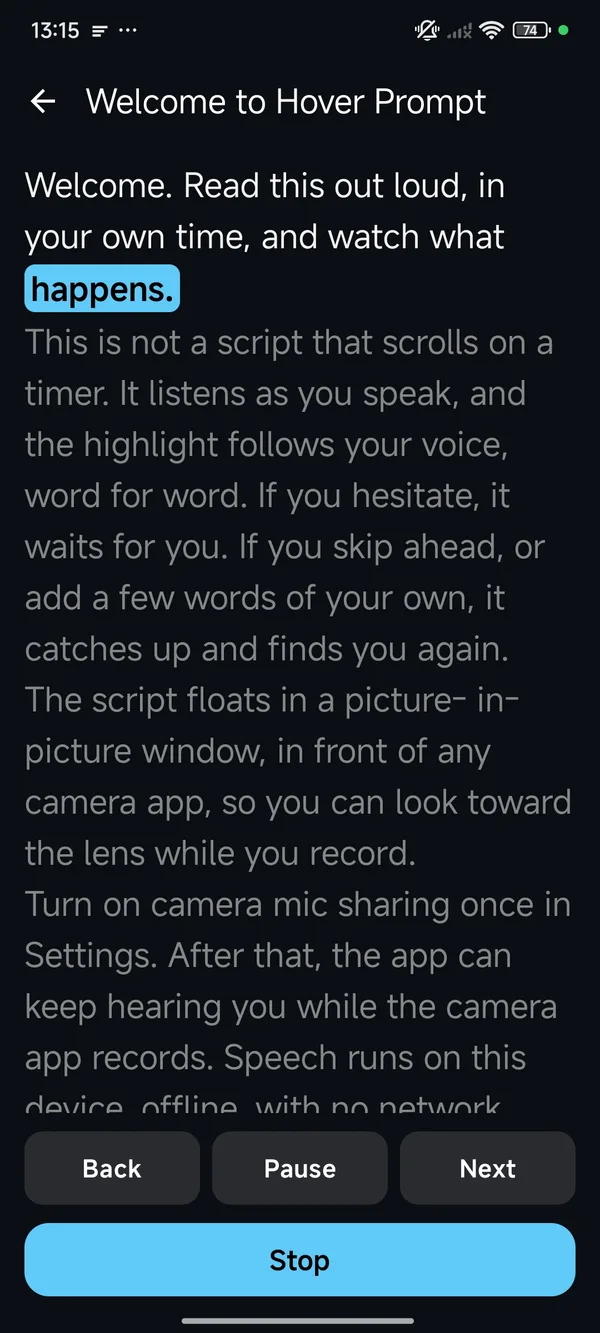
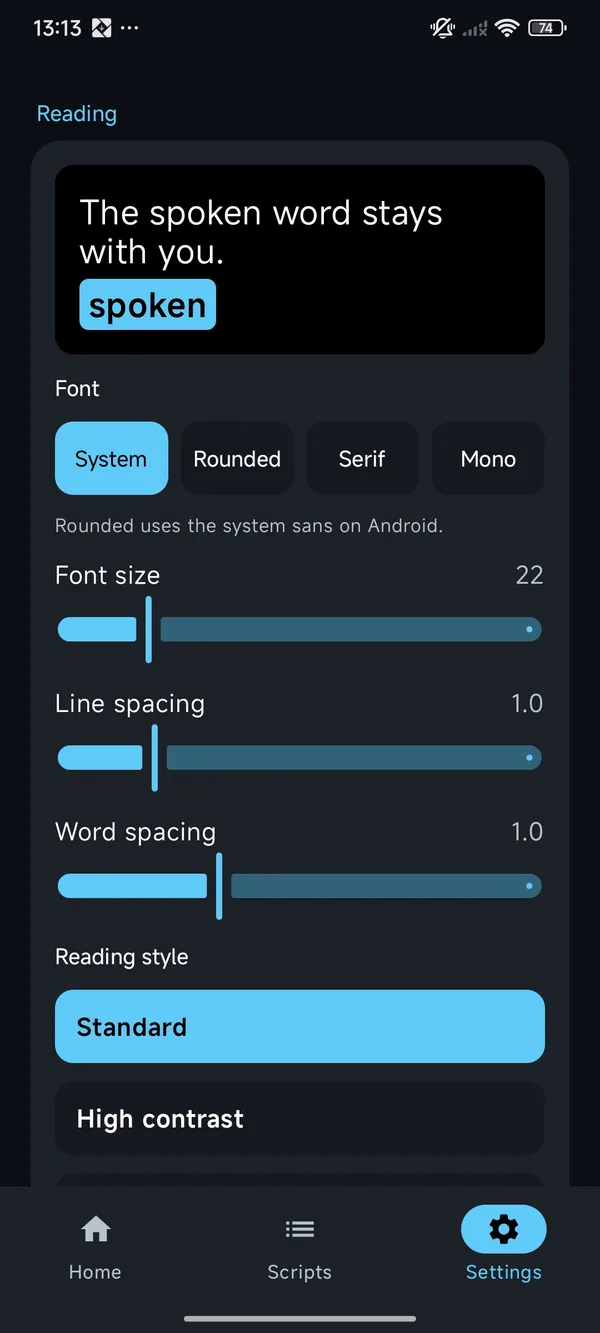
In Hover Prompt you can paste a script, type it, or import a file. On iPhone and iPad that means .txt, .md or .rtf. On Mac and Android you can also import .docx, and on Mac you can drag and drop. In Settings, increase the text size, add a little line spacing, and pick a highlight color that stands out against your room.
Put the words next to the lens
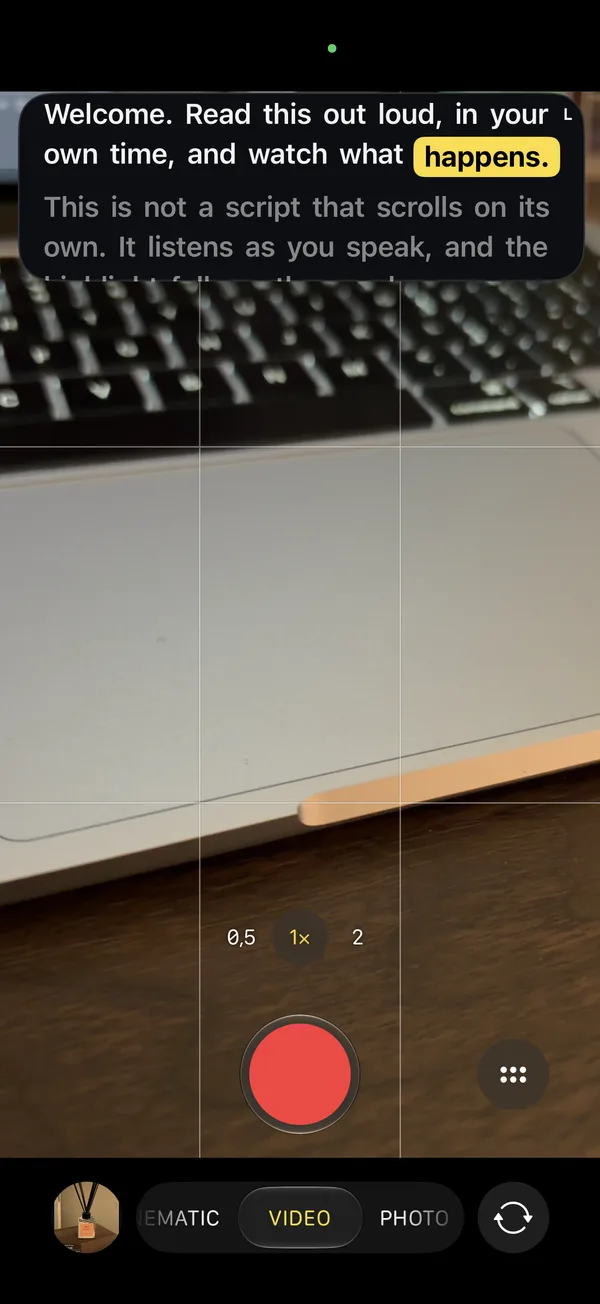
The closer the words sit to the lens, the less your eyes have to move, and the less a viewer notices that you’re reading. A small window right beside the camera beats a big one a few centimeters away.
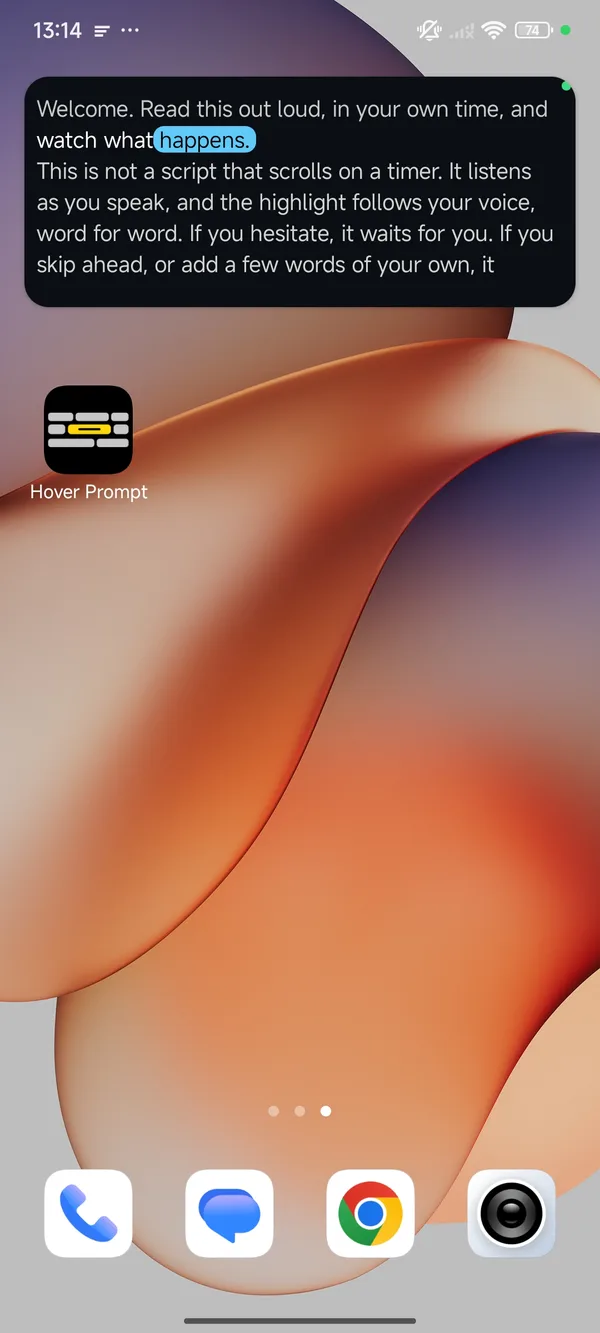
Hover Prompt doesn’t record video. Your script floats over Camera, or whichever app you already film with, in a Picture-in-Picture window you can drag anywhere.
- Open Hover Prompt and choose a script. Start with the demo, or paste, type or import your own.
- Tap Start Hover Prompt, then tap play. The first time, allow Microphone and Speech Recognition access. On iPhone or iPad, also turn on Dictation (Settings > General > Keyboard) and pick a language that supports on-device speech recognition.
- Say a sentence, then stop. The current word should light up, and the script should wait when you go quiet.
- Swipe up while it’s playing. Press play first, or the window won’t appear.
- Open Camera, switch to the front camera, and drag the window beside the lens. If it covers your eyes or mouth in the preview, nudge it toward the corner nearest the lens.
Use the front camera so you can see both yourself and the script. With the rear camera, the screen faces away from you.
Controlling the script hands-free. Say “Hover,” pause for a beat, then say “pause,” “resume,” “next sentence” or “go to start.” Voice commands work on iPhone, iPad and Android, and you can change the trigger word and phrases in Settings. On Mac you use keyboard shortcuts instead. A green meter on the window shows when the microphone can hear you.
On iPhone and iPad, the floating window has no buttons; tapping it takes you back to Hover Prompt. On iPhone you can tuck the script into the Dynamic Island, but for reading, keep the larger window by the lens.
On Android, drag the floating window up near your camera and tap it to pause or resume. A one-time camera mic sharing setup keeps the mic connected while you film in another app. It never reads your screen.
Set up the shot
Put the lens at eye level, about an arm’s length away (50 to 70 centimeters). A stack of books, a clamp or a small stand all work. Too close and your eyes visibly track across each line; too far and you’ll squint.
Light your face from the front or from a window to one side, never from behind you.
Record a few seconds and play them back before the full take. Check the actual video file, not a screen recording: the floating window can show up in a screen recording, but Camera captures only what the lens sees.
For more on lighting and the Camera audio setting, see How to use a teleprompter on iPhone while recording video.
Stop chasing a scrolling script
A timed-scroll teleprompter keeps moving whether you’re talking or not. When you pause to look at the lens, the text has already run ahead, and your next glance turns into a hunt.
Hover Prompt follows the words you say instead. The current word lights up, the script keeps pace with you, and it waits when you stop. If you skip a line or speed up, it finds you again.
Speech is recognized on your device just to move the highlight. It’s never recorded, saved or uploaded, and once the speech model is on your device, reading and voice sync work offline.
For what “voice-activated” should mean in a teleprompter, see Voice-activated teleprompter app for iPhone.
Rehearse the look once
Read the demo script aloud once to check that the highlight keeps up and the text is big enough from where you’re standing. Then read your own script once without recording. If you have to lean in or squint, increase the text size before you hit record.
On the real take, use a simple rhythm:
- Glance at the next line.
- Lift your eyes to the lens.
- Say it to one person you have in mind, not to an audience.
Use the blank lines to settle your eyes back on the lens. If you need a breath, take it; the highlight will wait. If you lose your place, say “Hover,” then “go to start” or “next sentence.” A second take is completely normal.
Other ways to read a script on camera
A hardware teleprompter reflects your script into the camera’s line of sight, so your eyes stay on the lens. It’s excellent if you already own the rig, and extra gear to buy and carry if you don’t.
A timed-scroll app works if you speak at a steady pace, but the text keeps moving when you look at the camera. Set it slightly slower than feels natural, and put the window close to the lens.
Paper or cue cards are fine for a few large bullet points taped beside the lens, and awkward for a full script.
A recording app with built-in scrolling text is a fair option if you’re happy to film in that app. A floating window lets you stay in Camera, or the app you already use, and edit in your usual tools afterwards.
This guide uses Hover Prompt because the words can sit right next to the lens, and the highlight follows what you actually say.
When your eyes still leave the lens
The lines are too long or the type is too small. Break each line into six to ten words, then increase the text size and line spacing in Settings until you can read it comfortably from an arm’s length away.
The window sits too far from the lens. Drag it right beside the camera, as close as you can without covering your face in the preview.
You can’t see the script while filming. You’re probably on the rear camera. Switch to the front camera.
The window never appears. You probably swiped away while the script was paused. Press play, then swipe up.
The highlight doesn’t move. Check the green meter first. Then make sure Microphone and Speech Recognition are allowed for Hover Prompt. On iPhone or iPad, check Settings > Privacy & Security, make sure Dictation is on, and wait for the on-device speech model to finish downloading. In Camera, turn on Allow Audio Playback if you see the option.
You went off-script. The highlight waits and picks up again when you come back to the words. To jump back to the top, say “Hover,” then “go to start.”
Still stuck? The support page walks through the permission steps in order. For privacy details, see the privacy policy.
Questions
Can I read a script on camera without looking away from the lens?
Yes. Put the words right beside the lens, keep the lines short enough to take in at a glance, and use a script that waits when you look up instead of scrolling away.
Will the script show up in the video?
Not in a Camera recording, which captures only what the lens sees. The floating window can appear in a screen recording, so move it or check the playback if you're recording your screen.
Do I need a hardware teleprompter?
No. A hardware rig is a good option if you already have one, but a floating window next to the lens is enough for most phone videos.
What if I pause or lose my place?
The highlight waits while you pause and picks up when you start talking again. If you skip a line or speed up, it finds you again. To jump around hands-free on iPhone, iPad or Android, say "Hover," then "next sentence" or "go to start."
Does this work on iPhone and Android?
Yes. Hover Prompt is a teleprompter for iPhone, iPad, Mac and Android. You can try it free with the built-in demo script on the App Store and on Google Play.